
Last Updated: September 2026
Jim Corbett Safari Rules 2026: Latest Guidelines, Mobile Ban, ID & Booking Rules
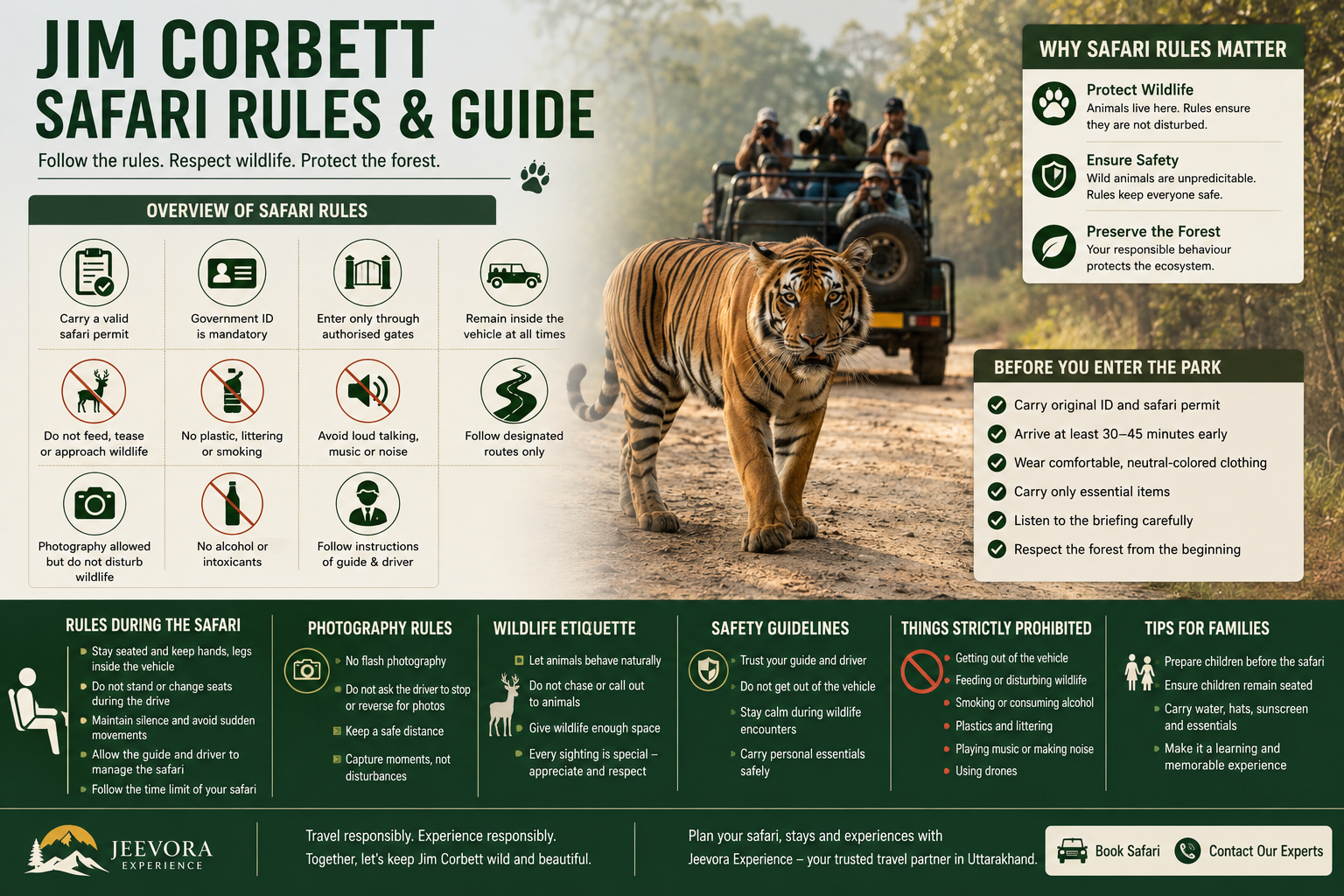
Planning a Jim Corbett safari in 2026? The rules have become more important than ever. Along with the usual wildlife etiquette and safety requirements, Corbett Tiger Reserve has introduced or reinforced important requirements around mobile phones, printed permits, original ID verification, online booking, visitor waiting time, vehicle allocation and monsoon bookings. Before you leave, it is also worth checking the Jim Corbett Safari Permit Guide so your permit and visitor details are ready correctly.
This updated guide brings the key 2026 rules together in one place so you can prepare correctly before reaching the safari gate. Because the reserve regularly publishes new notices, always check the latest official Corbett Tiger Reserve information before your visit.
Quick 2026 Rule Summary
- Mobile phone use is prohibited in tourism zones within the Corbett Tiger Reserve core habitat.
- If a visitor brings a phone for a day safari, it must be deposited in the locker facility at the gate.
- A printed hard copy of the online permit and the original valid ID are mandatory at entry.
- Correct identity-document details must be entered/uploaded during booking.
- A mandatory 180-second waiting period applies on the Visitor Details page during safari and night-stay booking.
- Jeep Safari bookings can open progressively up to 45 days in advance.
- A maximum of 6 individuals can be included in one Jeep Safari booking.
- Tickets are non-refundable and non-transferable after payment.
- During monsoon, the booking window may operate only up to T+7 days and entry can be restricted because of weather or safety.
- Current official notices specify 6:30 AM as the online-booking cut-off for the morning session and 4:00 PM for the afternoon session on the visit date.
1. Mobile Phone Ban in Jim Corbett Safari
One of the most important 2026 changes is the strict restriction on mobile phones inside Corbett Tiger Reserve tourism zones. The reserve says the rule is being implemented in compliance with a Supreme Court judgment dated 17 November 2025 concerning mobile-phone use in tourism zones of tiger-reserve core habitat.
Mobile-phone use is strictly prohibited in all tourism zones within Corbett Tiger Reserve. Visitors are requested to leave phones at their accommodation before entering the safari zone. If a tourist nevertheless brings a phone for a day safari, it must be deposited at the locker facility available at the gate.
This means you should not plan to use WhatsApp, Instagram, reels, live location sharing or ordinary phone photography during the safari.
2. Printed Safari Permit + Original ID Are Mandatory
Do not rely only on the QR code or a screenshot on your phone. The current official visitor notice says tourists must present:
- Hard copy / printout of the online reserved permit
- Valid original identity card
These documents must be presented to the relevant gate or reception in-charge at entry.
Before leaving your hotel, keep the printed permit and original ID together in a waterproof folder or document pouch.
3. Correct ID Details Are Critical During Booking
The official booking process requires accurate visitor details including name, gender, country, ID proof type, ID number and age. Original ID details are mandatory.
The reserve has also issued a notice stating that the correct ID proof must be uploaded during booking and that the ID will be verified at entry. If the uploaded ID does not match the ID presented at entry, access can be restricted.
Never enter a different person's ID simply because that person's document is available. The details should correspond to the traveller covered by the permit.
4. Jim Corbett Safari Booking Window
The official booking process currently states that Jeep Safari reservations open progressively each day and can be made up to 45 days in advance.
For popular dates, weekends and preferred zones, booking earlier is sensible. Availability is never guaranteed simply because the booking window has opened.
For the complete booking process, see our Jim Corbett Safari Booking 2026 guide.
5. Maximum 6 People in One Jeep Safari Booking
If you are planning a larger group, our Jim Corbett with Family guide can help you structure the wider trip around the safari.
The official booking process allows a maximum of 6 individuals per Jeep Safari booking.
The current pricing page also states that a safari permit allows a maximum of six individuals, including up to two children under 12.
If you are travelling with a school, college, corporate or large family group, plan the required permits/vehicles in advance instead of trying to fit everyone into one booking.
6. Dhikala Day Safari Rule
For a detailed comparison of the available safari options, see our Jeep Safari vs Canter Safari guide.
Jeep Safari is not available for Dhikala day visits. The official booking process directs day visitors to choose Canter Safari for Dhikala.
If you want to stay inside the Dhikala area, night-stay arrangements are a separate booking category and should be planned independently.
7. 180-Second Waiting Period During Booking
The current official Corbett website states that a mandatory 180-second waiting period applies on the Visitor Details page during Night Stay and Safari booking.
Even if you complete the visitor form early, you must wait for the full 180 seconds before proceeding to the next step.
This is important when booking a high-demand date: do not assume that refreshing the page or rushing through the form will bypass the waiting period.
8. Same-Day Online Booking Cut-Off Times
The current official notice states the following online booking cut-offs for the visit date:
| Safari Session | Last online booking time |
|---|---|
| Morning | 6:30 AM |
| Afternoon | 4:00 PM |
These are booking cut-off times, not the safari departure/reporting time. Your actual reporting and safari timing should be followed from the permit and instructions issued for your selected zone and date.
9. Monsoon Safari & Booking Rules
For broader seasonal planning, see our Jim Corbett in Monsoon guide before finalising your dates.
Monsoon requires additional caution because heavy rain can affect forest roads, tourism-zone operations and visitor safety.
The current official notice says that during monsoon the booking window will open only for T+7 days. It also warns that entry can be restricted because of security reasons, heavy rain or unforeseen circumstances.
The reserve states that once a permit is reserved, the amount is non-refundable and the permit cannot be changed. The notice also specifically advises visitors to check the weather forecast before booking.
10. Safari Permits Are Non-Refundable & Non-Transferable
Do not book a safari assuming that you can freely cancel or transfer it later. The official booking process states that tickets are non-refundable and non-transferable after payment.
This is particularly important for monsoon trips and travel plans that depend on road or weather conditions.
11. Vehicle Allocation & Selection
The current official Corbett information includes a vehicle-selection and allocation process. The official visitor notice says a preferred vehicle can be selected from the booking date until three days before the trip. If no preferred vehicle is selected, the allocation system can automatically assign a suitable vehicle based on availability.
The official booking-process page also currently describes an option to change/select a specific Gypsy within 8 hours of booking. Because the reserve's live booking notices can change the operational process, travellers should follow the vehicle-selection option and deadline actually displayed in the official portal for their permit.
12. Only Authorised Guides & Gypsies Are Allowed
If you are comparing safari options and planning costs, review the Jim Corbett Safari Booking 2026 guide before choosing your booking.
The current official pricing information states that only authorised guides and Gypsies are permitted inside Corbett Tiger Reserve.
Do not arrange an unofficial vehicle or guide simply because someone offers a cheaper safari outside the official system.
13. Wildlife Etiquette Rules You Must Follow
The administrative rules are only one part of responsible safari behaviour. Inside the forest:
- Never feed wildlife.
- Never chase an animal.
- Never ask the driver to leave an authorised route.
- Do not shout, whistle or make sounds to attract wildlife.
- Do not attempt to block an animal's path.
- Do not leave the safari vehicle unless specifically permitted.
- Keep noise low.
- Do not throw food, plastic or any other waste.
- Follow the driver and nature guide's instructions.
- Never use an unauthorised drone.
14. Photography Rules
Photography is an important part of a Corbett safari, but wildlife welfare comes first.
- Do not use flash on wildlife.
- Do not make sounds to make an animal look toward the camera.
- Do not pressure a driver to chase an animal for a photograph.
- Respect other visitors during wildlife sightings.
- Follow all current restrictions on mobile phones and electronic devices.
For dedicated camera advice, see our Jim Corbett Wildlife Photography Guide 2026.
15. Safari Zone Rules & Seasonal Access
Choosing the right zone is an important part of following the booking process. Our Jim Corbett Safari Zones Guide explains the main zone differences.
Different tourism zones can have different operating periods. The current official pricing page, for example, lists year-round day-safari availability for Jhirna and Dhela, while Bijrani and Garjia are listed from 15 October to 30 June, and Durgadevi, Sonanadi and Pakhro from 15 November to 15 June.
These dates should be treated as the current published reference rather than a permanent rule. Weather, forest conditions and administrative notices can affect access.
For a zone-by-zone comparison, read our Jim Corbett Safari Zones Guide.
16. Current Safari Pricing Reminder
For a more detailed fare breakdown, compare this with our Jim Corbett National Park Ticket Price guide.
The current official tariff lists a day-safari Indian permit at ₹3,380 for the listed zones. Vehicle and guide charges vary by zone. The current official guide-charge listing is ₹1,000.
Indian national students aged 12–18 currently qualify for a ₹375 per-person discount when they present a valid student ID. A permit allows up to six individuals, including up to two children under 12.
For the complete pricing breakdown, see our Jim Corbett National Park Ticket Price 2026 guide.
17. New Monitoring Measures for the 2026–27 Tourism Season
These monitoring measures sit alongside the existing visitor and safari compliance framework; they should not be confused with a separate booking category.
Recent reporting about the tourism season beginning 15 November 2026 describes additional high-tech monitoring measures planned for Corbett, including GPS-equipped safari Gypsies, drone monitoring and additional CCTV surveillance.
These measures should be understood as announced/upcoming monitoring measures rather than replacing the existing visitor rules. The objective is to improve route compliance, visitor safety and wildlife protection.
The reserve already describes its real-time vehicle-tracking technology as part of its digital monitoring and safety system.
18. What to Carry for a Jim Corbett Safari
For a complete packing checklist, see our Jim Corbett Packing List.
- Printed safari permit
- Original valid ID
- Season-appropriate clothing
- Water bottle
- Sunglasses
- Sunscreen
- Binoculars
- Camera where permitted under the current rules
- Basic personal medicines
Do not carry your mobile phone into the tourism zone unless you are following the current gate/locker procedure.
For a broader checklist, read our Jim Corbett Packing List.
Planning a trip like this? Let our team help you build the perfect itinerary.
19. What Happens If You Break the Rules?
Consequences depend on the nature of the violation and the applicable forest and wildlife regulations. Entry can be restricted when mandatory documents do not match, and visitors can face action for prohibited activities.
Do not treat safari rules as optional. The rules exist to protect visitors, wildlife and the integrity of the protected area.
Jim Corbett Safari: 2026 Pre-Departure Checklist
| Check | Done? |
|---|---|
| Safari permit printed | □ |
| Original ID matches booking | □ |
| Student ID carried, if claiming concession | □ |
| Mobile phone left at accommodation / locker plan understood | □ |
| Correct safari zone and gate confirmed | □ |
| Reporting time checked | □ |
| Weather checked | □ |
| Safari vehicle details checked | □ |
| Required clothing and water packed | □ |
Frequently Asked Questions
Is mobile phone allowed in Jim Corbett Safari?
No. Mobile-phone use is prohibited in tourism zones within Corbett Tiger Reserve. Visitors are advised to leave phones at their accommodation; if a phone is brought for a day safari, it must be deposited in the locker facility at the gate.
Is a printed Jim Corbett safari permit mandatory?
Yes. The current official visitor notice requires a hard copy of the online reserved permit along with a valid original identity card at entry.
How many people can travel in one Jim Corbett Jeep Safari?
A maximum of 6 individuals can be included in one Jeep Safari booking.
How early can I book Jim Corbett Jeep Safari?
The official booking process currently allows reservations up to 45 days in advance, with availability opening progressively.
What is the 180-second rule in Jim Corbett booking?
A mandatory 180-second waiting period applies on the Visitor Details page during Safari and Night Stay booking. You must wait the full period before proceeding.
What is the last online booking time for Jim Corbett Safari?
The current official notice lists 6:30 AM as the morning-session online booking cut-off and 4:00 PM for the afternoon session on the visit date.
Can I cancel or transfer my Jim Corbett safari ticket?
The current official booking information states that tickets are non-refundable and non-transferable after payment.
Can I take a Jeep Safari in Dhikala?
Not for a regular day visit. The official booking process says Jeep Safari is not available in Dhikala Zone for day visits; visitors should choose Canter Safari.
Can I select my safari vehicle?
The reserve provides a vehicle-selection/allocation process. Because the current official pages describe different selection timing instructions, follow the option and deadline displayed in the live official booking portal for your permit.
Are there new monitoring rules for the 2026–27 season?
Recent reporting describes planned GPS-equipped Gypsies, drone monitoring and additional CCTV surveillance for the tourism season beginning 15 November 2026. These are additional monitoring measures rather than a replacement for existing visitor rules.
Planning Your Jim Corbett Safari?
Jeevora Experience can help you plan safari, stays, transport and nearby Uttarakhand experiences while keeping the itinerary aligned with the latest published rules.

Comments