
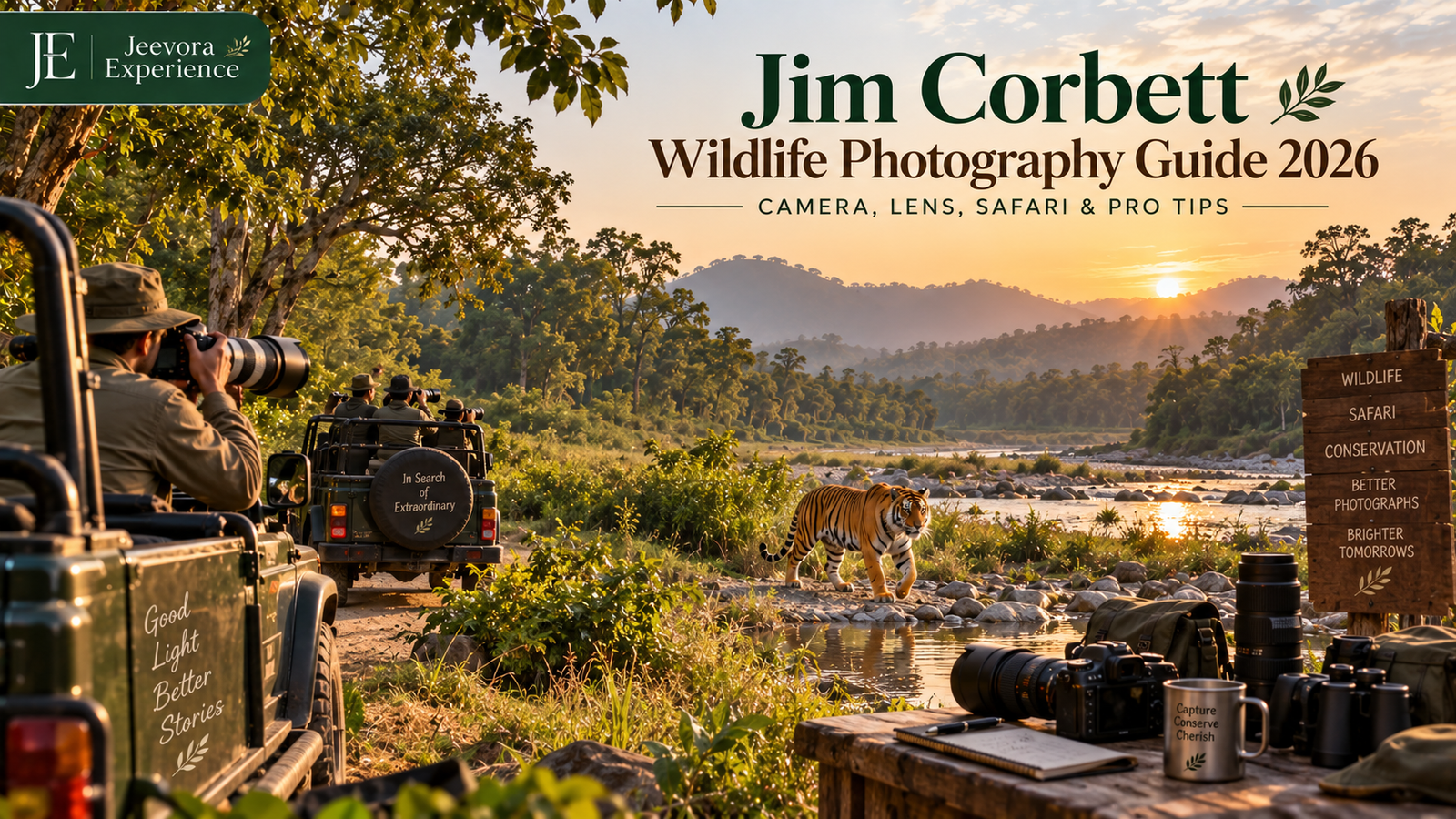
Jim Corbett Wildlife Photography Guide 2026: Camera, Lens, Safari & Pro Tips
Jim Corbett is one of India's most exciting destinations for wildlife and nature photography. A safari can give photographers opportunities to capture tigers, elephants, deer, birds, reptiles, forest landscapes, rivers and changing light—all in an unpredictable natural environment.
But good Corbett photography is not simply about carrying an expensive camera. Safari timing, light, lens reach, camera settings, patience, vehicle position and responsible wildlife behaviour often matter more than the price of your equipment.
This Jim Corbett wildlife photography guide 2026 covers the practical information you need before a photography-focused safari, from choosing a camera and lens to handling low light, photographing birds, protecting equipment and getting better photographs without disturbing wildlife.
Quick Answer: How Do You Get Better Wildlife Photos in Jim Corbett?
For a photography-focused trip, prioritise an early safari, a suitable telephoto lens, fast shutter speeds, extra batteries and memory cards, and a quiet, patient approach. A Jeep Safari is generally more convenient for serious photographers because the smaller group and open vehicle design provide more flexibility than a larger shared vehicle. However, wildlife sightings and photographic opportunities are never guaranteed.
Why Jim Corbett Is Good for Wildlife Photography
Corbett offers varied photographic subjects rather than only tiger photography. Forest roads, sal trees, grasslands, rivers, birds, elephants, deer, crocodiles and changing Himalayan foothill landscapes can all become part of a complete photo story.
The wider Corbett region also offers different visual environments. Sitabani, Marchula, the Kosi landscape, forest edges and safari zones can produce very different photographs depending on weather, season and light.
Our Things to Do in Jim Corbett guide is useful if you want to combine photography with sightseeing and other experiences.
Best Safari for Wildlife Photography: Jeep vs Canter
| Factor | Jeep Safari | Canter Safari |
|---|---|---|
| Passenger count | Smaller group | Larger shared group |
| Camera space | Generally better | More limited |
| View flexibility | Usually easier for photographers | More dependent on seating |
| Landscape photography | Excellent | Good |
| Serious wildlife photography | Usually preferred | Can still produce excellent images |
For photographers, a Jeep Safari is usually the more practical option when available. A Canter can still provide excellent landscape, bird and wildlife opportunities, especially when the larger elevated vehicle gives a wider view.
Read our Jeep Safari vs Canter Safari comparison and Jim Corbett Safari Booking 2026 guide before choosing your safari.
Best Time for Wildlife Photography in Jim Corbett
| Period | Photography Advantage | What to Expect |
|---|---|---|
| October–February | Soft light and comfortable temperatures | Birds, landscapes and pleasant safari conditions |
| March–April | Increasing wildlife activity and changing vegetation | Good balance of weather and wildlife photography |
| May–June | Longer dry periods and stronger wildlife-viewing opportunities | Hot conditions; early starts are important |
| Monsoon | Lush landscapes and dramatic weather | Some core safari areas may be closed or access may change |
Our Best Time to Visit Jim Corbett guide provides a broader month-by-month planning view. For photography, remember that good light and wildlife behaviour are not predictable on every safari.
Best Safari Timing for Photography
Early Morning
Morning safaris can offer soft light, cooler temperatures and an active forest atmosphere. The lower-angle sunlight can create attractive highlights and shadows across forest roads and animals.
Late Afternoon
Afternoon light becomes warmer as the sun moves lower. This can be excellent for backlighting, silhouettes and golden forest scenes, depending on weather and animal movement.
Do not select a safari solely because you expect a tiger. The best photography trip is one where you are prepared to photograph whatever the forest presents.
Camera Gear for Jim Corbett
1. Camera Body
A DSLR or mirrorless camera with dependable autofocus and good high-ISO performance is useful for wildlife. You do not need the newest flagship body to make good photographs.
2. Telephoto Lens
A telephoto lens is the most important piece of wildlife-photography equipment. A roughly 300–600mm equivalent range can be useful depending on your camera system and the distance to the subject.
3. Wide-Angle Lens
A wide-angle lens is valuable for forest landscapes, rivers, sunrise scenes, environmental portraits and photographs where the animal is only part of the composition.
4. Extra Batteries
Cold mornings, repeated autofocus and long safari sessions can drain batteries faster than expected. Carry at least one fully charged spare.
5. Extra Memory Cards
Wildlife action can produce a large number of frames. Carry reliable, sufficiently fast cards and avoid depending on one card for the entire trip.
6. Lens Protection
Dust, rain and road vibration are part of safari travel. A simple rain cover, cleaning cloth and protective camera bag can be more useful than carrying unnecessary accessories.
7. Bean Bag or Support
A compact bean bag or suitable support can help stabilise a long lens inside a safari vehicle. Confirm how and where equipment can be positioned without interfering with other passengers.
Camera Settings for Jim Corbett Wildlife Photography
| Situation | Starting Point |
|---|---|
| Moving animal | Shutter priority / around 1/1000s or faster |
| Fast bird in flight | Often 1/1600s–1/2500s or faster |
| Stationary animal | Around 1/500s–1/1000s depending on lens and movement |
| Low light | Increase ISO rather than allowing dangerous motion blur |
| Landscape | Lower ISO and appropriate aperture where movement is not an issue |
These are starting points rather than fixed rules. Wildlife moves unpredictably, light changes quickly and your camera system behaves differently at different ISO values and apertures.
Autofocus Tips
- Use continuous autofocus for moving subjects.
- Use animal/eye detection if your camera provides a reliable wildlife mode.
- Keep the focus area controlled enough to avoid locking onto branches.
- Track the subject before pressing the shutter repeatedly.
- For birds in flight, use a wider focus area if your camera handles tracking well.
- Review images occasionally, but do not spend the whole safari looking at the screen.
How to Photograph a Tiger in Jim Corbett
A tiger sighting can happen quickly, and the first photographs are often imperfect. The best response is to stay calm and follow your guide's instructions.
- Prepare the camera before an expected sighting.
- Keep a suitable shutter speed ready.
- Do not use flash.
- Do not shout or make sounds to get the tiger to look at you.
- Do not ask the driver to chase, block or pressure the animal.
- Capture behaviour and surroundings, not only headshots.
- Leave room in the frame when the animal is moving.
Our Best Time for Tiger Sighting in Jim Corbett guide can help with broader wildlife-viewing planning.
Bird Photography in Jim Corbett
Bird photography can be especially rewarding because Corbett supports a large variety of resident and migratory birds. A telephoto lens, patience and knowledge of bird behaviour are often more important than simply increasing focal length.
For bird-specific locations, seasons and species, read our Birds of Jim Corbett guide.
- Watch tree canopies as well as the ground.
- Look near water and forest edges.
- Use a fast shutter speed for birds in flight.
- Try to photograph against clean backgrounds.
- Do not approach nesting birds.
- Listen for calls before searching visually.
Wildlife Photography Beyond Tigers
One of the biggest mistakes is treating a Corbett safari as a tiger-only photography trip. Elephants, deer, crocodiles, birds, monkeys, butterflies, reptiles and forest landscapes can produce memorable photographs.
Some of the strongest images may have no large animal at all: mist between sal trees, a bird perched against clean light, an elephant herd crossing a road, reflections near water or a winding forest track can tell the story of the destination.
Best Photography Subjects in Corbett
| Subject | Photography Approach |
|---|---|
| Tiger | Fast shutter, telephoto, patience |
| Elephant | Environmental compositions and behaviour |
| Deer | Portraits, groups and alert behaviour |
| Birds | Telephoto, high shutter speed and clean backgrounds |
| Crocodiles | Long-lens detail and habitat context |
| Forest | Wide-angle compositions and layered light |
| Rivers | Reflections, landscapes and wildlife context |
| Butterflies | Close-focus/telephoto work and patience |
Photography Spots and Landscapes to Look For
Kosi River Landscape
The Kosi landscape can provide opportunities for river, forest and bird photography. Early and late light can create more depth and texture than harsh midday sunlight.
Sitabani Forest
Sitabani is useful for travellers interested in quieter forest and landscape photography. Read our Sitabani Forest Guide before planning the visit.
Marchula
Marchula's forested hills and Ramganga River setting can add a different visual style to a Corbett photography itinerary. Our Marchula Uttarakhand Travel Guide covers the destination in more detail.
Garjiya Devi Temple
For architecture, river and landscape photography, Garjiya offers a different subject from a wildlife safari. Follow local customs and any photography restrictions at the temple.
Responsible Wildlife Photography Rules
Photography should never take priority over wildlife welfare. Jim Corbett is a protected wildlife habitat, not a controlled studio environment.
- Never use flash on wildlife.
- Never feed or bait animals.
- Never make sounds to attract an animal.
- Never ask the driver to chase wildlife for a photograph.
- Stay inside the safari vehicle unless authorised officials instruct otherwise.
- Do not leave designated routes.
- Keep noise low.
- Respect other safari vehicles and photographers.
- Never use an unauthorised drone in the protected area.
For the full safety and etiquette framework, read our Jim Corbett Safari Rules & Guide.
Photography Etiquette Inside a Shared Safari
Even when you have excellent equipment, remember that other passengers have paid for the same wildlife experience.
- Do not occupy the best viewing position for the entire safari.
- Give other passengers an opportunity to see important sightings.
- Keep large bags and equipment organised.
- Avoid sudden movements when animals are close.
- Do not use loud shutter sounds or music.
- Follow the driver's instructions during crowded sightings.
Mobile Photography in Jim Corbett
You do not need a professional camera to document your trip. A modern smartphone can produce excellent landscape, forest, river and close-range images.
For distant wildlife, however, a phone's digital zoom can quickly reduce image quality. Instead of relying entirely on zoom, use the phone for landscapes, environmental photographs and closer subjects while enjoying wildlife sightings with your own eyes.
Photography Packing Checklist
- Camera body
- Telephoto lens
- Wide-angle lens
- Extra batteries
- Memory cards
- Lens cleaning cloth
- Rain cover
- Camera bag
- Compact bean bag/support
- Binoculars
- Power bank
- Comfortable neutral-coloured clothing
Our Jim Corbett Packing List can be used alongside this checklist for the rest of your trip.
How Many Safaris Should a Wildlife Photographer Plan?
There is no magic number. One safari can produce a memorable image, while several safaris may produce no major predator sighting at all. If photography is a primary goal, planning multiple safari drives gives you more opportunities to work with different light, routes, weather and wildlife behaviour.
Instead of repeating the same expectations, use each safari differently: one for landscapes and birds, another for wildlife, and another for slower observation and environmental images.
Sample 2-Day Photography Itinerary
| Day | Plan |
|---|---|
| Day 1 | Arrive → check-in → rest → afternoon safari → sunset/landscape photography. |
| Day 2 | Early morning safari → breakfast → nature/bird photography → local scenic stop → departure. |
Sample 3-Day Wildlife Photography Itinerary
| Day | Plan |
|---|---|
| Day 1 | Arrival → equipment preparation → relaxed local photography → early dinner. |
| Day 2 | Morning safari → rest and image backup → afternoon safari or birdwatching. |
| Day 3 | Early safari → breakfast → landscape photography around the wider Corbett region → departure. |
Photography Budget for a Jim Corbett Trip
| Expense | What Changes the Cost? |
|---|---|
| Camera gear | Existing equipment vs rental/purchase |
| Safari | Zone, permit, vehicle and guide charges |
| Accommodation | Budget, mid-range or luxury resort |
| Transport | Private car, taxi or group vehicle |
| Additional activities | Birding, nature walks and local experiences |
For the complete trip-cost framework, see our Jim Corbett Trip Cost Guide.
Common Wildlife Photography Mistakes
- Using too slow a shutter speed for moving wildlife.
- Carrying too much equipment into the safari vehicle.
- Checking the LCD constantly instead of watching the forest.
- Using excessive digital zoom on smartphones.
- Ignoring background clutter.
- Forgetting spare batteries or memory cards.
- Expecting a tiger sighting on every drive.
- Trying to get closer to wildlife for a bigger photograph.
- Ignoring fellow passengers while chasing a shot.
- Forgetting that ethical behaviour is more important than the perfect image.
Frequently Asked Questions
What camera is best for Jim Corbett wildlife photography?
A DSLR or mirrorless camera with reliable autofocus, good high-ISO performance and a suitable telephoto lens is a practical choice. The camera brand matters less than the complete setup and your ability to use it quickly.
What lens should I carry for a Corbett safari?
A telephoto lens with roughly 300–600mm equivalent reach can be useful for wildlife and birds. A wide-angle lens is valuable for forests, rivers and landscapes.
Planning a trip like this? Let our team help you build the perfect itinerary.
Is a Jeep Safari better for photographers?
Usually, yes. A Jeep generally provides fewer passengers, more flexible viewing and easier access to camera equipment. However, a Canter can also produce excellent wildlife and landscape photographs.
What is the best time for wildlife photography in Jim Corbett?
March to June is often attractive for wildlife photography because of warmer, drier conditions and potentially better visibility, while October to February can offer comfortable weather and excellent bird and landscape photography. Actual sightings and light conditions vary.
Can I use flash photography during safari?
Flash should not be used on wildlife. It can disturb animals and is unnecessary for most outdoor safari photography.
Can I use a drone for wildlife photography in Jim Corbett?
Do not assume drone use is permitted. Protected-area rules and permissions apply, and unauthorised drone use should be avoided.
Is Jim Corbett good for bird photography?
Yes. The Corbett region supports a wide variety of resident and migratory birds. Patience, early starts, binoculars and a suitable telephoto lens can significantly improve the experience.
How many safaris should a photographer book?
If photography is your main purpose, multiple safaris provide more opportunities across different light and conditions. There is no guaranteed number of drives for a particular wildlife sighting.
Plan a Photography-Focused Jim Corbett Trip
Want to plan Corbett around wildlife photography, birding and safari? Share your dates, group size, preferred safari experience and accommodation budget. Jeevora Experience can help structure a practical photography-focused itinerary.
Final Takeaway
The best Jim Corbett wildlife photographs come from preparation, patience and respect for the forest. A good telephoto lens helps, but understanding light, choosing sensible camera settings, watching animal behaviour and staying calm during sightings are just as important.
Plan your safari carefully, carry only the equipment you can comfortably manage, and remember that the goal is to document wildlife without changing its behaviour. That approach will usually produce better photographs—and a better experience for everyone.
Comments